Florence is one of the great cities in the world. I have walked the Uffizi a hundred times and it still works on me. But Florence is a city, and Tuscany is not a city. Tuscany is the country around it. Cypress trees on ridge lines, walled towns nobody has bothered to update since the 14th century, cellars cut into tufa, and back roads that exist for the pleasure of driving them.
You need to leave Florence. You need a car and you need at least four days and you will want more.
Here is the route I run with my groups, minus a few stops I keep for paying customers.
Florence
Start here, one full day. The Duomo, the Uffizi, Ponte Vecchio. None of it disappoints in person. Book the Uffizi at uffizi.it weeks ahead or you will give up half a day in line.
Before you leave, cross the Arno into Oltrarno. This is where Florentines actually live. Leather workshops, frame restorers, the wine bars with fiaschi on the walls.
Have a glass of Chianti Classico at Le Volpi e l’Uva, which has been pouring serious wine by the glass since 1992. Eat at Il Santo Bevitore or, if you want it less polished, Trattoria Cammillo, where the tablecloths are paper and the bistecca is from Chianina cattle. Then get in the car.
Siena
An hour and a half south. Siena is the city Tuscany was before Florence pulled ahead. The two cities tore at each other for two centuries. Siena lost. It has been quietly, stubbornly itself ever since.
The Piazza del Campo is the best medieval square in Italy. Shell-shaped, slightly concave, with the Palazzo Pubblico anchoring the bottom. On Palio days, July 2 and August 16, fifty thousand people pack into it and the city becomes something else entirely. I have stood in that crowd twice and I will not do it a third time. Go on a Tuesday morning in April instead. Sit in the middle of the square and look up.
The Duomo is better than people expect. Striped black and white marble outside, an inlaid marble floor inside with fifty-six panels, and the Piccolomini Library upstairs where the Pinturicchio frescoes are still saturated with color five hundred years later.
Give Siena a day. Eat pici with wild boar ragù at Osteria Le Logge if you can get a table.
San Gimignano
The skyline with the fourteen surviving towers is on every postcard for a reason. Seventy-two stood once. Each family built theirs taller than the neighbor’s because that was the medieval version of a German car in the driveway. Fourteen are left.
Walk the town before 10am or after 5pm. Between those hours the tour buses arrive and the streets clog. Visit the Collegiata for the Lippi and Ghirlandaio frescoes. Then find the saffron shops. San Gimignano produces Zafferano DOP, real saffron grown in the surrounding hills, and a few grams of it will do more for a risotto than a whole jar of whatever you bought at home.
Then Gelateria Dondoli on the main piazza. It has won the World Gelato Championship more than once and the line moves fast. Get the Vernaccia di San Gimignano gelato, made with the local white wine, and eat it on the steps in front of the Collegiata.
Vernaccia is the only white in Tuscany with DOCG status and it is worth a glass at lunch too. Look for Panizzi or Montenidoli if you see them.
Volterra
Most people who do Tuscany never stop here. Their loss.
Volterra is older than Rome. The Etruscans built it on a high ridge with views in every direction. The town is smaller and darker than San Gimignano, cut from grey stone, with alleys so narrow the sky overhead feels like a different element.
The Museo Etrusco Guarnacci has one of the best collections of Etruscan funerary urns anywhere, and the alabaster workshops on the main streets are still working stone the way they have for 2,500 years. You can stand in a doorway and watch a man carve.
The pieces are the real Volterra souvenir, not the magnets stamped “Tuscany” you find downhill. Eat at Enoteca del Duca. The cinghiale, the local Sangiovese, the slow service. That is the meal.
Chianti
Not a town. A zone you drive through on the way to somewhere else.
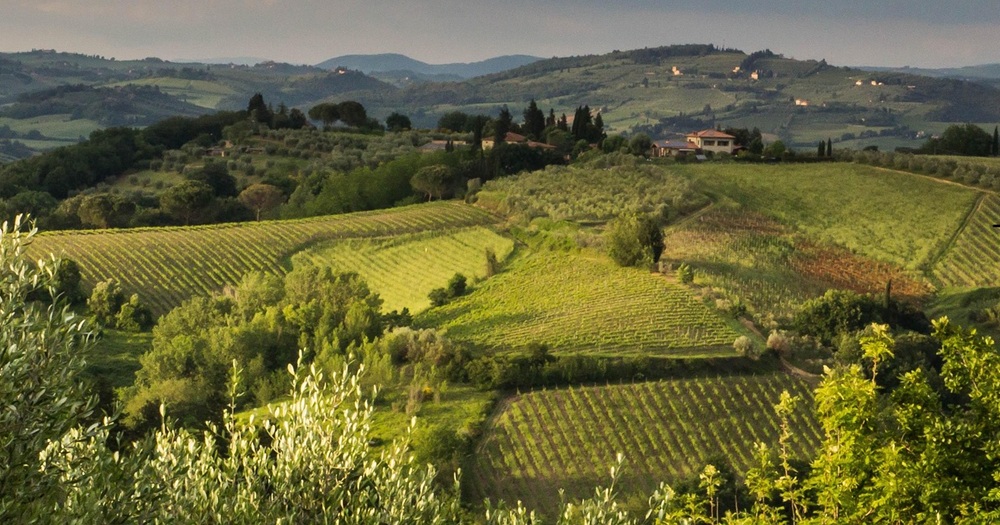
Take the SR222, the Chiantigiana, between Siena and Florence. This is the road through the heart of Chianti Classico. Cypress trees on the ridge roads, stone farmhouses on every other hilltop, castles producing wine since before the Medici. Look for the black rooster, the gallo nero, on the bottles. That is the Chianti Classico mark and what separates the real thing from supermarket Chianti.
Stop at a cantina when you see a sign. In Chianti you do not always need an appointment. Ring the bell. Castello di Ama, Felsina, Isole e Olena, and Montevertine are all serious. Montevertine’s Le Pergole Torte is one of the great wines of Italy and worth tasting if they will pour it for you. Drive slowly. That is the entire point.
Pienza
Pope Pius II was born in this village and decided, in 1459, to turn it into a perfect Renaissance city. He hired the architect Bernardo Rossellino and gave him five years. Cathedral, papal palace, town hall, main square, all built to mathematical Renaissance proportion.
The result is still standing and still functioning as a town. Walk to the loggia behind the cathedral. The view from there is the Val d’Orcia at its purest. Rolling hills, cypress lines, no visible modernity.
Pienza is also the capital of Pecorino di Pienza, the sheep’s milk cheese aged here in caves and in walnut leaves. Every shop on Corso Rossellino sells it at every stage. Buy fresco, semi-stagionato, and stagionato. Eat them in that order on a bench with a piece of bread and a spoon of acacia honey. That is lunch.
Val d’Orcia
Also not a town. The landscape stretched between Pienza, Montalcino, and San Quirico d’Orcia, and the most photographed countryside in Italy.
Clay hills called the crete senesi. Single stone farmhouses on the tops. Lines of cypresses leading up driveways. A road curving over a ridge in the distance that you can see for ten minutes before you reach it.
The light at 6pm in May turns everything amber. In spring the fields go green and red with poppies. In summer the wheat goes gold and gets cut into round bales that sit in the fields for a week before they move.
Drive the small roads. The SP146 between San Quirico and Pienza is the one everyone photographs. Stop whenever a view appears.
Montalcino
A small hilltop town with a 14th-century fortress and the most serious wine credentials in Tuscany. Brunello di Montalcino is made from a clone of Sangiovese called Sangiovese Grosso, aged a minimum of five years before release, two of those in oak.
The wines last decades. The 2010s are drinking beautifully right now. The 2016s are closed and you should leave them alone for another five years.
Walk into the Fortezza and taste at the Enoteca La Fortezza inside the walls. You can taste flights across multiple producers, which is the only honest way to learn the difference between Biondi-Santi, Soldera, Il Poggione, and Casanova di Neri.
Buy a bottle. Drink it with bistecca alla fiorentina or wild boar ragù at Re di Macchia or Boccon DiVino. The view from the fortress over the Val d’Orcia is worth the climb on its own.
Montepulciano
Montepulciano sits on a narrow ridge between two valleys. The main street climbs steeply through Renaissance palaces up to Piazza Grande, which is one of the great hilltop squares anywhere, with the Duomo, the Palazzo Comunale, and the old well facing each other across the stone.
The wine here is Vino Nobile di Montepulciano, also Sangiovese, different clone, different soil, different result. People compare it to Brunello and it does not need the comparison. It is its own thing. Find the underground cantine cut into the ridge beneath the main street. Avignonesi, Boscarelli, Salcheto. Several pour without an appointment.
The views from the city walls justify the walk on their own. Val di Chiana on one side, Val d’Orcia on the other.
Cortona
The Etruscan city above the Val di Chiana that everyone sees from the autostrada and most people drive past. Stop.
Cortona sits on a steep hillside facing south with views over the whole valley and Lago Trasimeno in the distance. The town is compact, stone, medieval, and quiet outside of summer. The Museo Diocesano holds an Annunciation by Fra Angelico that almost nobody lists when they talk about the great paintings of Tuscany. It belongs on the list.
Drive up from the valley in morning light. Coffee in the piazza. Walk to the top of the town where the streets give out and the hillside takes over.
Pitigliano
End here, in the southern part of Tuscany called the Maremma, where the landscape changes entirely and most tour groups never reach.
Pitigliano is built on a tufa cliff above a deep ravine. The town appears to grow out of the rock face itself, the buildings rising in a single mass that looks impossible from the approach road. It was called Little Jerusalem for centuries because of its Jewish community, which arrived in the 16th century fleeing persecution in the Papal States.
The synagogue is still there. The ghetto is still there. The bakery still makes sfratti, the Jewish-Tuscan honey and walnut pastry, which is the local thing to eat with a glass of Bianco di Pitigliano.
Below the town, the Etruscans cut tunnels through the tufa, the vie cave, some of them twenty meters deep, connecting the surrounding towns through a network nobody fully understands. Walk into them in the morning when they are still cool. The sound disappears in there.
Pitigliano is three hours from Florence and most people who have spent a week in Tuscany have never heard of it. Go anyway. Look at the town from the road as you come in. Understand that Tuscany contains more than the postcards show you.
What to Know Before You Drive
ZTL zones in every historic center. The white circle with red border means do not enter. The fine arrives at home four months after your trip through your rental company, eighty to three hundred and thirty-five euros per camera per entry, plus a forty euro admin fee for the privilege.
Park outside the walls. Walk in. If your hotel sits inside the zone, call them before you arrive and ask them to register your plate. Most can.
The small SP and SR roads are where Tuscany actually lives. The autostrada is for moving fast between places. The provincial roads are for the trip itself.
April, May, and September are the best months. October if you want to be there for the vendemmia, the grape harvest, and the white truffle season around San Miniato and Volterra. Skip August. Half the good restaurants close, the heat is brutal, and the Italians have left for the coast.
Book the Uffizi and the Accademia weeks ahead at the official sites if you are spending time in Florence. The queue otherwise eats half a day you do not have.